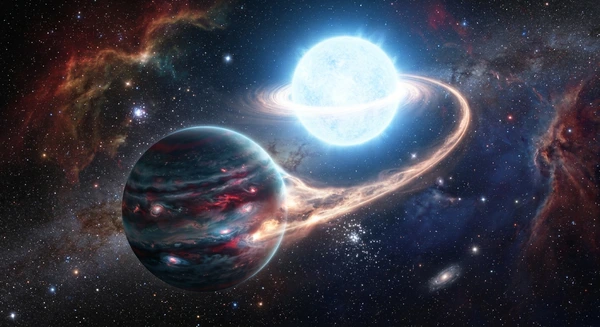

Scientists have identified a planet candidate that may have formed from material expelled by a dying star, offering a rare glimpse into how planetary systems can emerge from stellar destruction.
Astronomers have uncovered evidence of an unusual world that may have formed not alongside a newborn star, but from the material released as a star reached the end of its life. Nicknamed the Phoenix planet, the object is challenging conventional ideas about when and how planets can form.
The discovery centres on a compact stellar remnant known as a white dwarf, designated HS 0209+0832. Researchers believe the unusual chemical composition of this star’s atmosphere, combined with a repeating signal in its brightness, could point to a giant planet formed from material expelled during the star’s earlier evolution.
The findings, published in Nature Astronomy on October 5, 2026, describe the object as a second-generation planet candidate. Further evidence is needed to establish its nature conclusively.
What Makes the Phoenix Planet Different?
Most planets are thought to form from the clouds of gas and dust surrounding young stars. Over time, this material gathers into larger bodies, eventually producing planets, moons and other objects.
The proposed Phoenix planet may have followed a very different path.
A star can expand dramatically during the later stages of its life, shedding material into space before its core remains as a white dwarf. Under certain conditions, some of the expelled material may collect into a disc and eventually form new planets.
A planet created through this process is described as a second-generation planet. Instead of forming from the original material surrounding a young star, it would emerge from matter released during the star’s later evolution.
Although astronomers have considered the possibility of second-generation planets for years, finding a convincing example around a white dwarf would provide important evidence that planet formation can occur in environments very different from those in which our own Solar System developed.
Unusual Chemical Clues Point to a Possible New World
The research team investigated HS 0209+0832 after examining observations that revealed an unusual mixture of elements in its atmosphere.
Among the most striking findings were elevated amounts of copper, zinc and niobium. The researchers found that niobium was especially abundant compared with typical solar abundances.
These elements matter because some are associated with nuclear processes that take place inside ageing stars. As stars evolve, nuclear reactions can produce heavier elements, which may later be carried into space by stellar outflows.
The chemical pattern detected around HS 0209+0832 differs from what astronomers would ordinarily expect if the star were simply absorbing material from a typical rocky planetary body.
The researchers suggest that the white dwarf may instead be collecting material from a giant planet formed out of the star’s expelled matter. If so, the unusual elements could offer clues to the environment in which that planet developed.
The finding is significant because it gives scientists a possible way to identify other second-generation planet candidates: by searching for distinctive chemical signatures in the atmospheres of white dwarfs.
A Repeating Signal Provides Another Piece of Evidence
Chemical composition is not the only clue.
The team also examined brightness measurements from NASA’s Transiting Exoplanet Survey Satellite, or TESS. The observations revealed a repeating signal with a period of approximately 4.4 days.
The researchers interpret this variation as potentially consistent with a close-orbiting giant planet. It could reflect changes in the planet’s observed brightness during its orbit, although the precise interpretation remains part of the scientific analysis.
The proposed planet would orbit extremely close to the white dwarf. At such a short distance, it would be exposed to intense radiation from the hot stellar remnant.
That radiation is expected to heat and erode the planet’s outer atmosphere. Some of the escaping material could then fall onto the white dwarf, helping to explain the unusual chemical elements detected in its atmosphere.
This possible connection between the repeating brightness signal and the chemical evidence strengthens the planet explanation, but it does not remove the need for further investigation.
Why Would a Planet Form After Its Star Dies?
One of the biggest questions is how expelled stellar material could form a planet at all.
Material leaving an ageing star does not automatically settle into the stable, rotating disc needed for planet formation. Much of it may simply escape into space.
The research team suggests that the system may have required additional gravitational influence, potentially from a companion star, to help some of the expelled material remain in orbit and form a disc.
If a suitable disc developed, material within it could gradually gather into a new planetary body.
This makes the proposed Phoenix planet particularly interesting. It could demonstrate that the end of a star’s life does not necessarily mark the end of planet formation in that system.
However, the exact conditions required to create such a world remain uncertain. Astronomers will need to study more systems before they can determine how common this process might be.
Could Our Solar System Form a Second-Generation Planet?
The discovery also raises questions about the distant future of our own Solar System.
Billions of years from now, the Sun is expected to expand into a red giant and eventually leave behind a white dwarf. That transformation will profoundly alter the planets and smaller bodies orbiting it.
The Phoenix research does not show that a second-generation planet will form around the Sun’s remnant. Instead, it offers a possible example of a process that scientists can investigate to better understand the long-term evolution of planetary systems.
Finding additional examples would help astronomers determine whether second-generation planet formation is an exceptional event or a process that occurs more widely than previously recognised.
It could also reveal how the chemical composition of a planet reflects the history of the star from which its building material originated.
What Happens Next?
The central challenge is to establish whether HS 0209+0832 truly hosts a second-generation planet.
The current interpretation rests on several pieces of evidence, including the unusual chemical composition of the white dwarf’s atmosphere and the repeating brightness signal. Further observations and modelling can help test whether the planet explanation fits the data better than alternative possibilities.
Researchers may also search other white dwarfs for similar chemical signatures. If more candidates emerge, scientists could begin to build a clearer picture of how planets might form after their original stars have evolved.
For now, the Phoenix planet remains a compelling candidate rather than a fully established example of a world reborn from stellar remains.
Nevertheless, the research opens an intriguing possibility: the material released during a star’s final stages may not simply mark an ending. Under the right conditions, it could provide the ingredients for an entirely new planetary world.
Source note: This article is based on the research paper Discovery of a second-generation planet candidate accreting onto a white dwarf, published in Nature Astronomy, and the University of Warwick’s research announcement. The planet’s proposed origin remains subject to further scientific investigation.