Honda’s Mobile Power Pack e: swappable battery has received the Sustainability & Circular Economy Excellence Award at The Battery Show 2026, highlighting the growing interest in battery systems designed to serve multiple electric products.
The award, announced by American Honda on October 14, comes as the company expands efforts to make the battery available to other manufacturers in the United States. Honda is positioning the Mobile Power Pack e: as a standardised energy solution that could support a wider range of mobility products and equipment.
The strategy reflects a broader challenge facing electric mobility: batteries must do more than store energy. Convenient charging, manageable costs, reliable operation and practical replacement systems can all influence whether businesses adopt electric equipment.
What is Honda’s Mobile Power Pack e:?
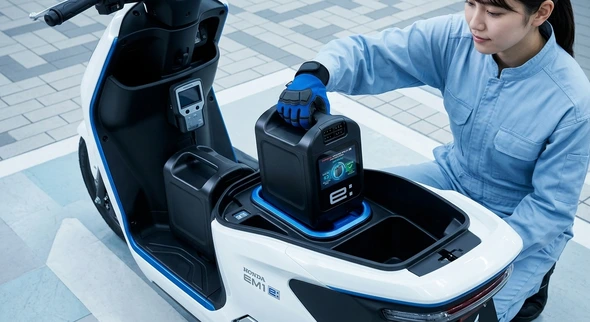
The Honda Mobile Power Pack e: is a portable, removable battery designed to be taken out of compatible equipment and replaced with a charged unit.
This approach differs from conventional electric vehicles and equipment that rely primarily on charging a battery while it remains installed. With a compatible swapping system, an operator can exchange a depleted battery for a charged one rather than waiting for the installed battery to recharge.
Honda has developed the technology for applications including electric scooters and other power equipment. Its wider battery business also explores ways to use portable battery packs across different products and settings.
The key idea is flexibility. If the same battery platform can support multiple compatible products, manufacturers and operators may be able to simplify some aspects of charging, maintenance and energy management.
However, compatibility is essential. A common battery platform does not mean that the pack can be inserted into any electric scooter, machine or appliance. Products need suitable electrical connections, control systems, safety features and mechanical designs.
Why battery swapping matters for electric mobility
Charging time remains an important consideration for businesses that depend on equipment throughout the day. Delivery fleets, commercial operators and industrial users may lose productive time if vehicles or machines have to remain out of service while their batteries recharge.
Battery swapping can offer an alternative. Operators with access to charged replacement packs can potentially return equipment to service more quickly, provided that compatible batteries and appropriate charging or exchange facilities are available.
The approach may also support centralised battery management. A business could charge packs in a designated area and distribute them to equipment as needed, instead of requiring every machine to remain connected to a charger.
There are trade-offs. Operators may need to purchase additional batteries, maintain charging infrastructure and manage the collection, inspection and replacement of battery packs. The economics depend on utilisation, battery lifespan, electricity costs, equipment compatibility and the availability of a dependable supply of charged units.
For some applications, conventional plug-in charging may remain simpler and more economical. Swapping is most attractive where equipment is used intensively and downtime carries a meaningful cost.
Honda wants other manufacturers to use the battery
The most significant part of Honda’s announcement is its business-to-business offering in the United States.
Honda says it has begun offering the Mobile Power Pack e: to companies interested in integrating the battery into products made by other original equipment manufacturers, commonly known as OEMs.
That opens the possibility of Honda supplying a battery platform for applications beyond its own branded mobility products. Potential areas of interest include commercial electric equipment and other compatible mobile energy applications.
For Honda, wider adoption could help extend the usefulness of the battery technology beyond a single product category. For participating manufacturers, integrating an established battery platform could offer an alternative to developing an entirely separate battery solution.
But an open invitation to manufacturers is not the same as a mature, widely adopted ecosystem. Honda has not identified specific new integration partners in its award announcement, nor has it published a complete list of products from other manufacturers that will use the battery under this new US offering.
The commercial opportunity will depend on whether manufacturers see sufficient value in adopting the platform and whether Honda can support their technical and operational requirements.
What the sustainability award recognises
The Sustainability & Circular Economy Excellence Award was presented at The Battery Show 2026, an event focused on battery technology and electric-vehicle innovation.
Honda says the award recognises excellence in battery technology. Its announcement does not provide detailed judging criteria or identify the other finalists, so the award should not be interpreted as proof that the battery is the most sustainable option across the entire industry.
Nevertheless, the technology’s emphasis on reuse across compatible products is relevant to the circular-economy discussion.
A shared battery platform could create opportunities to manage packs centrally, maintain them across their useful lives and potentially recover materials when they reach the end of service. Replacing a battery does not automatically mean that the whole vehicle or machine must be discarded.
The environmental outcome, however, depends on more than the design alone. Battery manufacturing, electricity sources, transportation, durability, repairability, recycling processes and the number of useful operating cycles all affect the overall footprint.
Battery swapping can reduce operational waiting time, but its broader environmental benefits need to be assessed across the battery’s lifecycle.
Could the model work beyond scooters?
Honda’s wider ambitions raise an important question: can a battery originally associated with electric mobility become a useful component across several types of equipment?
A shared platform could be attractive in settings where multiple compatible machines operate in the same location. Commercial facilities, delivery operations and certain industrial environments may benefit from having replacement batteries ready when equipment needs them.
Yet each application brings different power requirements, operating conditions and safety considerations. A battery system suited to a small electric scooter may not automatically meet the needs of larger equipment.
The platform’s success will therefore depend on the range of supported applications, the cost of integration and whether enough manufacturers participate to make the system convenient for customers.
Standardisation can create value when many products adopt the same approach. Without broad compatibility and sufficient battery availability, however, swapping systems can remain limited to specific products or operators.
What comes next for Honda’s battery strategy?
Honda’s award provides recognition for the Mobile Power Pack e:, but the next stage is commercial execution.
The company will need to demonstrate that other manufacturers are willing to integrate the battery and that the system delivers practical benefits outside its existing applications. Clear information about compatibility, pricing, battery availability, charging systems and long-term operating costs will help businesses evaluate the proposition.
For customers, the central question is not simply whether a battery can be swapped. It is whether swapping makes equipment more productive and economical over its working life.
If Honda can establish a reliable platform used by multiple manufacturers, the Mobile Power Pack e: could become part of a broader approach to electric mobility and mobile energy. If adoption remains limited, the technology may continue to serve a narrower set of compatible products.
The award marks a positive milestone for Honda, but the longer-term measure of success will be real-world adoption, dependable operation and the value the system delivers to businesses and users.
Sources
- American Honda — Mobile Power Pack e: Wins Sustainability & Circular Economy Excellence Award
- Honda Global — Mobile Power Pack Business
- The EV Report — Honda Mobile Power Pack e: Battery Show Award
NM Focus analysis based on Honda’s announcement and published industry coverage. Potential applications and benefits depend on product compatibility, operating conditions and commercial adoption.