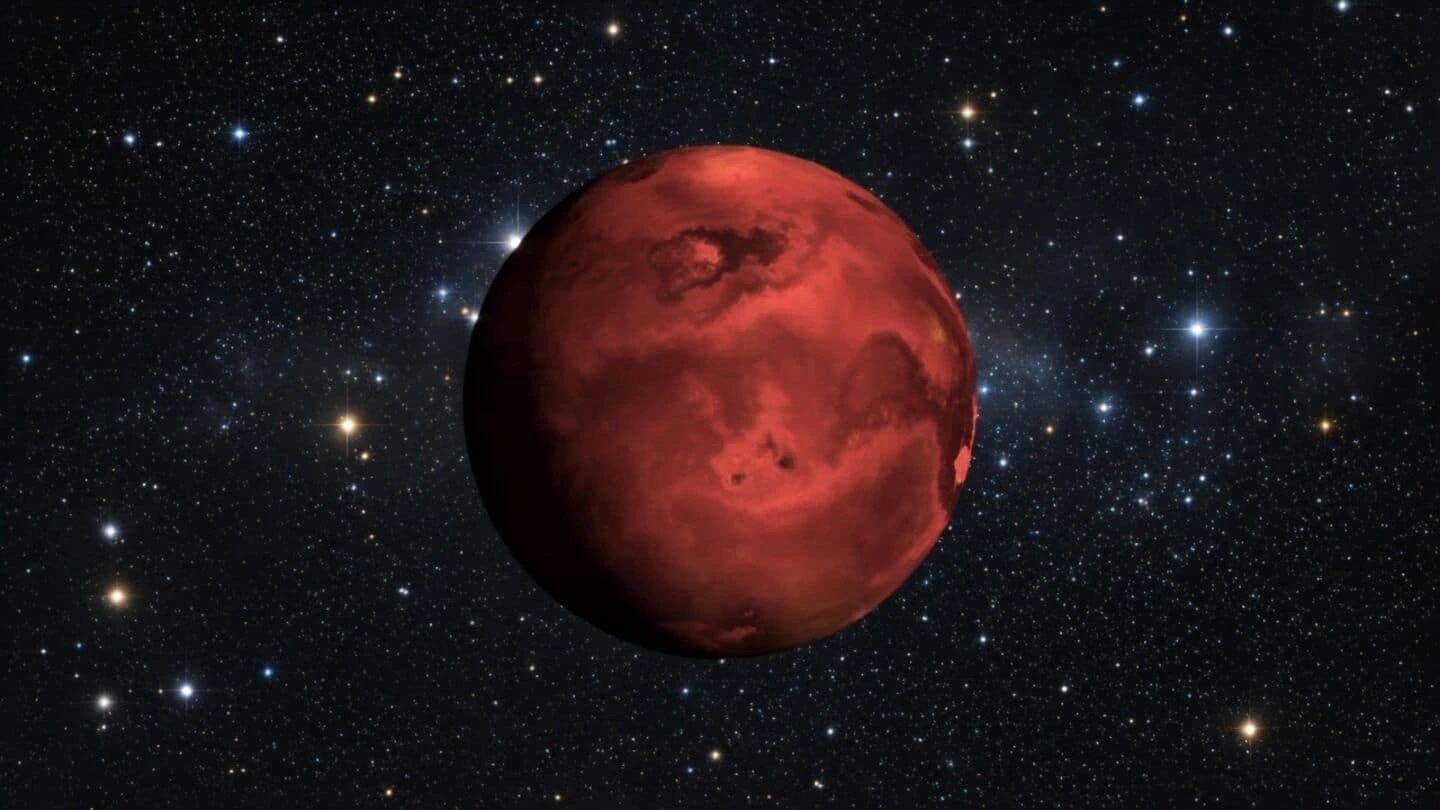

Astronomers are studying a strange rocky world called HD 3167 b, where an atmosphere appears to redistribute heat despite the planet orbiting extremely close to its star. The findings could offer a new window into the fiery early history of Earth.
Earth may look peaceful from space, with its blue oceans, clouds and continents. But our planet did not always look this way. Billions of years ago, during its earliest stages of formation, Earth was likely an intensely hot world where large areas of the surface existed as molten rock.
Now, astronomers are investigating a distant planet that may help them understand some of the conditions that shaped those early years.
The planet, known as HD 3167 b, is a rocky world located approximately 154 light-years from Earth. It belongs to a class of planets commonly called lava worlds because their surfaces can become hot enough for rock to melt. Yet this particular planet presents a scientific puzzle: despite its extremely close orbit around its star, it appears cooler than researchers would expect for a world without an atmosphere.
The findings, reported in September 2026, add to a growing body of research into the atmospheres of rocky planets beyond our solar system.
A Planet With a Remarkably Short Year
HD 3167 b follows an extraordinarily tight orbit around its host star. One complete revolution takes approximately one Earth day.
For comparison, Earth requires about 365 days to complete its journey around the Sun. HD 3167 b’s close orbit exposes it to intense stellar radiation, creating conditions very different from those found on our planet.
Scientists believe the planet is tidally locked, meaning one side permanently faces its star while the opposite side remains turned away. This arrangement can create a major temperature contrast between the illuminated and dark hemispheres.
On a world without an atmosphere, the dayside would be expected to become exceptionally hot because there would be little means of transporting heat away from the surface. The cooler-than-expected observations therefore provide an important clue about what may be happening around this distant planet.
The Atmospheric Clue Behind the Discovery
Researchers used the James Webb Space Telescope’s Mid-Infrared Instrument, known as MIRI, to study the planet’s thermal emissions.
The team observed HD 3167 b during a secondary eclipse. This occurs when a planet passes behind its star from our point of view. By comparing the infrared signal before and during the eclipse, astronomers can estimate how much heat the planet’s visible hemisphere contributes.
The measurements indicated that the planet’s dayside was cooler than expected under a no-atmosphere scenario. Researchers interpreted this as evidence that HD 3167 b likely has an atmosphere.
An atmosphere can influence a planet’s temperature in several ways. Gases may absorb and redistribute energy, moving some heat from the dayside towards the nightside. Depending on the atmosphere’s composition and cloud properties, it may also reflect some incoming stellar radiation back into space.
The observations are especially interesting because intense radiation from a nearby star can gradually strip a small rocky planet of its atmosphere. HD 3167 b appears to challenge simple expectations about how readily these worlds lose their gaseous envelopes.
However, the observations do not by themselves provide a complete chemical inventory of the atmosphere. Further measurements will be needed to determine its composition and understand how effectively it moves heat.
Why Scientists Are Looking Back at Early Earth
The connection to Earth is what makes this discovery particularly compelling.
Our planet formed roughly 4.6 billion years ago as material orbiting the young Sun gradually came together. During this process, collisions between growing planetary bodies released enormous amounts of energy. Additional heat came from processes inside the forming planet.
Scientists believe early Earth experienced a magma-ocean phase, when substantial portions of its surface were molten. As the planet cooled, its surface and interior evolved, helping establish the conditions that eventually allowed oceans and an atmosphere to develop.
HD 3167 b is not a direct replica of early Earth. Its present-day orbit and radiation environment are radically different from those of our planet. Nevertheless, studying its hot rocky surface and possible atmosphere may help researchers test ideas about how rocky planets behave when they are extremely hot.
The comparison is useful because the earliest stages of Earth’s development cannot be observed directly. Scientists must reconstruct them using ancient minerals, geological evidence, physical models and observations of other planetary systems.
Distant lava worlds provide another way to investigate the physics of molten rocky planets.
Lava Worlds May Be More Diverse Than Expected
Astronomers have discovered a growing variety of exoplanets, ranging from enormous gas giants to small rocky bodies. Lava worlds are particularly valuable because they allow scientists to investigate how intense radiation, surface temperature and atmospheric conditions interact.
One important question is how planets retain atmospheres under extreme conditions.
A planet’s atmosphere can influence its climate, surface temperature and long-term evolution. But atmospheric survival depends on several factors, including the planet’s gravity, its proximity to its star, the activity of that star and the composition of the gases surrounding the planet.
Researchers are investigating a broader group of lava worlds to determine whether atmospheres are common among these extreme rocky planets and how their properties change with temperature.
HD 3167 b contributes to this effort by showing that a rocky planet close to its star may behave differently from the simplest predictions. It also reinforces the value of observing several planets rather than drawing broad conclusions from a single example.
Does This Mean the Planet Could Support Life?
Despite the intriguing comparison with Earth’s past, HD 3167 b should not be described as a promising habitable planet.
Its close orbit and extreme surface conditions make it very different from Earth today. The possible presence of an atmosphere does not establish that the planet has liquid water, suitable surface conditions or any form of life.
Scientists study many planets that are unsuitable for life because they can reveal important information about planetary physics. Understanding how an atmosphere behaves on a hot rocky world can help researchers interpret observations of cooler planets, including worlds that may have more favourable conditions.
In astronomy, learning why a planet cannot support familiar forms of life can be just as useful as finding one that might.
The James Webb Telescope Is Changing Exoplanet Research
The James Webb Space Telescope was designed to observe the universe in infrared wavelengths, allowing scientists to investigate distant galaxies, forming stars and planets outside our solar system.
For exoplanet research, infrared observations are particularly useful for studying the heat emitted by a planet and analysing the signatures of gases in its atmosphere.
Rather than simply detecting that a planet exists, researchers can use these measurements to investigate its physical environment. Each observation helps narrow down possible explanations for how the planet formed, how it retains its atmosphere and how energy moves across its surface.
The work on HD 3167 b demonstrates how observations of unusual worlds can test scientific models that might otherwise remain difficult to evaluate.
Future observations of this and other rocky exoplanets could help determine whether their atmospheres contain particular gases, how efficiently they redistribute heat and how their conditions change over time.
NM Focus Analysis: Strange Planets Can Tell Us About Our Own
The most important aspect of the HD 3167 b discovery is not that astronomers have found another unusual planet. It is that this world may help answer a fundamental question: how do rocky planets evolve from hot, unstable beginnings into the environments we observe today?
Earth’s early history remains difficult to reconstruct because much of the evidence from its first stages has been altered or destroyed by billions of years of geological activity. Other planetary systems offer a natural laboratory for testing some of the processes involved.
There are important limits to this comparison. HD 3167 b is not a time capsule containing an untouched version of ancient Earth, and the planet’s current environment is not identical to the conditions that existed in our young solar system. The scientific value lies in comparing physical processes, not assuming the two planets followed the same path.
The research also highlights a wider shift in astronomy. Discovering an exoplanet is only the beginning. Scientists increasingly want to understand its atmosphere, climate, surface conditions and history. Powerful telescopes are helping turn distant points of light into worlds that can be studied in much greater detail.
For NM Focus, the central takeaway is clear: a planet that appears completely inhospitable can still help scientists understand the conditions that made our own world what it is today.
HD 3167 b may never resemble the Earth we know. But by studying how this extreme world manages its heat and possibly retains an atmosphere, researchers could gain valuable insights into the early evolution of rocky planets—including our own.
Source: Reporting and research context from Space.com, including observations described in the study published in The Astrophysical Journal Letters.