
Microsoft is taking a creative approach to promoting Windows PCs, using a new advertising campaign to connect computing power with the ideas, projects and ambitions that keep people working long after inspiration first strikes.
Developed with creative agency Droga5 New York, part of Accenture Song, the campaign is titled “What Will You Do With All This Power?” Its central film, “Obsession Comes Around,” celebrates the people who push their work further, including coders, gamers, visual artists and game developers.
Rather than focusing exclusively on technical specifications, the campaign puts the creative process at the centre of its message: powerful hardware matters when it helps people turn ambitious ideas into finished work.
A camera that keeps coming around
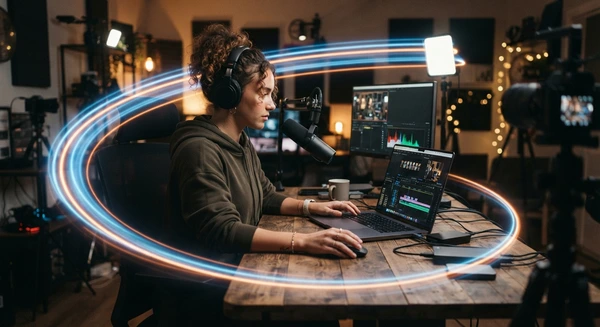
Directed by Ryan Chun of magna studios US, the main film uses continuous camera-orbit movements to create a sense of repetition and progression.
Each time the camera returns to a scene, the activity has moved forward. A project develops, an idea grows, or a creator takes another step towards a more ambitious result. The repeated movement reinforces the campaign’s central theme: creative people rarely stop at their first idea.
Music also plays an important role. The film features a reworked version of the familiar song “She’ll Be Coming ’Round the Mountain,” performed by Anna Graceman, with new lyrics built around the creative process.
The combination of recurring visuals, recognisable music and evolving scenes gives the advertisement a distinctive structure. Instead of presenting a conventional sequence of product shots and technical claims, it attempts to make the audience feel the momentum of sustained creative work.
Why Microsoft is focusing on creative workloads
The campaign promotes Windows laptops and PCs powered by NVIDIA RTX technology, positioning them for people who need to manage demanding tasks.
Modern creative and technical workflows can involve several intensive activities at once: editing large files, developing software, rendering visual projects, running AI tools and playing games. For these users, performance is not simply about how quickly a computer opens an application. It is also about how well the machine handles complex tasks without interrupting the user’s workflow.
Microsoft’s campaign turns that practical consideration into an emotional message. The computer is presented as a tool that should keep pace with a user’s ambition, rather than become an obstacle to it.
That is a familiar strategy in technology marketing, but the creative execution matters. Specifications may appeal to buyers comparing products, while a story about an artist completing a project or a developer pursuing an idea can help a broader audience understand why performance matters in everyday life.
The campaign’s claims about product capabilities should still be assessed against the specifications of individual PCs. Performance can vary according to the hardware configuration, software, workload and power settings.
A broader shift in how technology is marketed
Technology brands have traditionally relied heavily on processor speeds, graphics performance, battery life and other measurable specifications. Those details remain important, particularly for buyers who understand the technical differences between devices.
However, a campaign built around creative ambition reflects another side of the purchasing decision: people also want to understand what a device might help them accomplish.
For a game developer, that could mean building more complex environments. For a visual artist, it could mean working with demanding graphics applications. For a software developer, it might mean managing multiple tools and processes more efficiently.
By bringing these different users together under one idea, Microsoft can speak to several audiences without making the campaign feel like a technical presentation aimed at just one group.
The approach also gives the Windows brand a role beyond the physical computer. It positions the platform as part of a larger creative process in which hardware, software and the user’s own ideas work together.
The role of Droga5 and creative execution
The campaign is another collaboration between Microsoft’s Windows creative team and Droga5. It follows their earlier work on “Doppelmode,” a campaign that explored the relationship between productivity and personal interests.
With “Obsession Comes Around,” the creative emphasis shifts towards persistence and the way ideas develop through repeated effort. The camera movement and music are not merely decorative choices; they support the concept behind the campaign.
This illustrates an important point about advertising in a crowded technology market. When multiple products promise speed, capability and productivity, brands need more than a list of features to establish a memorable identity. A distinctive visual idea can help make a technical message easier to recognise and recall.
The campaign is scheduled to run across television, streaming, social media, digital advertising, search, creator content and media partnerships. Its planned placements include NFL Monday Night Football, giving the work exposure beyond audiences who actively follow technology advertising.
What the campaign means for Windows buyers
The advertisement does not, by itself, establish that every promoted PC will deliver the same experience or outperform every competing machine. Buyers should still compare specific configurations, graphics hardware, memory, storage, cooling, battery life and price before making a purchase.
Its more important message is about the intended role of a high-performance computer. Microsoft wants potential buyers to think not only about the device they are purchasing, but also about the work they want to do with it.
That message may resonate with professionals and enthusiasts whose projects place sustained demands on their machines. For everyday users with lighter workloads, however, the most powerful available hardware may not be necessary.
Ultimately, “Obsession Comes Around” makes a creative argument for computing power rather than attempting to turn the advertisement into a technical benchmark. Its effectiveness will depend on whether the film connects with viewers and whether the actual products deliver value for the people it targets.
For Microsoft, the campaign is a reminder that technology advertising can be about more than the machine itself. By focusing on the people behind the screen, Windows is selling the possibilities that computing power can help unlock.
Sources
- Little Black Book (LBB): Microsoft Windows Go ‘Round and ‘Round for Most Advanced Laptops Ever
- Marketing Communication News: Microsoft Windows and Droga5 capture the swirling momentum of creation
NM Focus analysis based on published campaign coverage. Product capabilities and advertising claims should be checked against the specifications of individual devices.