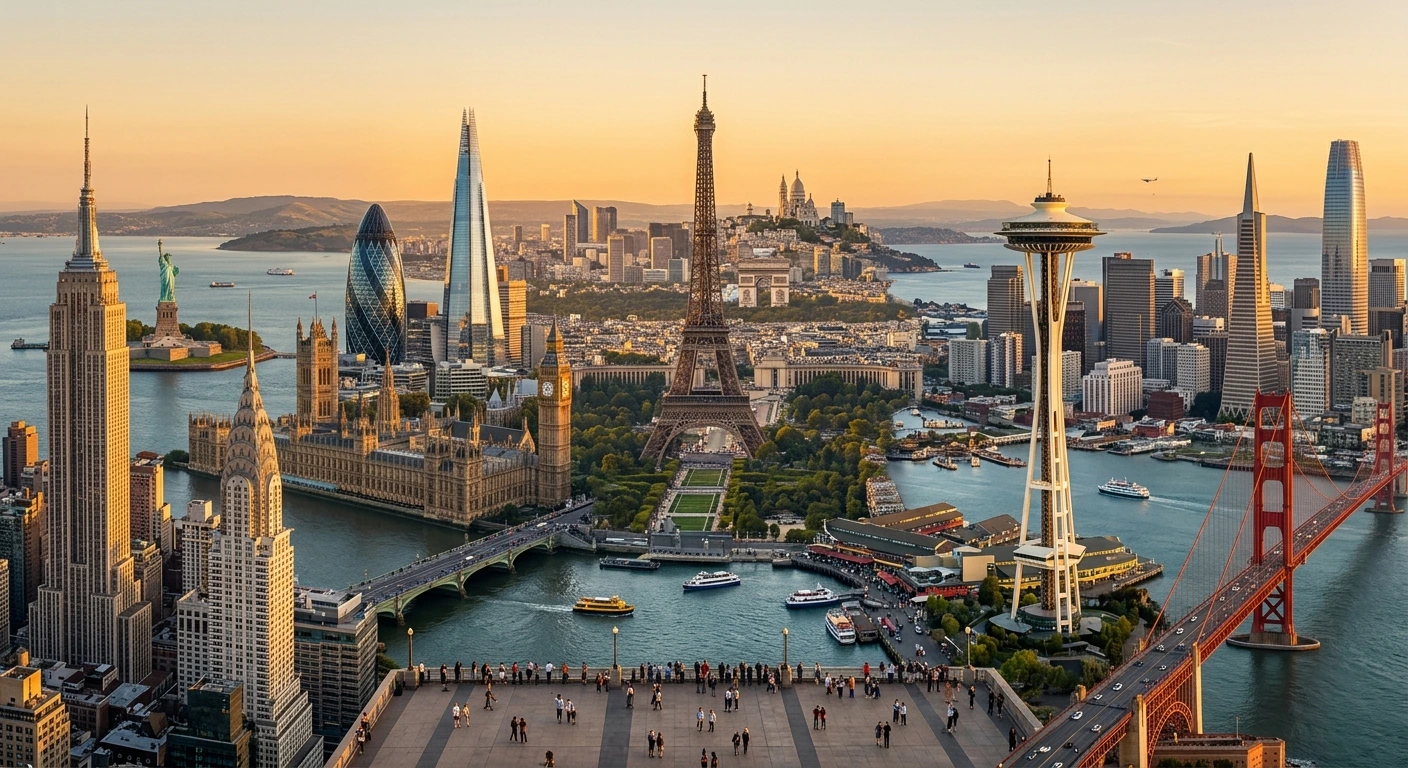

New York, London and Paris occupy the top three positions in the 2026 global cities ranking. But the results reveal a more complicated picture of urban success, where economic power, talent, quality of life and environmental performance do not always move together.
The world’s leading cities compete for more than tourists. They compete for businesses, investment, skilled workers, universities and the people who will shape the next generation of economic growth.
Some have built their influence around finance and technology. Others benefit from strong public institutions, international connectivity, established universities or a high standard of living. Increasingly, however, cities must balance these advantages against rising living costs, environmental pressures and the challenge of making urban growth work for ordinary residents.
The 2026 Global Cities Index from Oxford Economics offers a way to compare these competing strengths. It evaluates 1,000 cities across five broad areas, producing an overall ranking that reflects more than economic size alone.
New York takes first place, with London second and Paris third. The United States has five cities in the top 10, while European cities feature prominently throughout the leading positions.
Yet the rankings also reveal a central contradiction: a city can be an economic powerhouse without offering the best environmental conditions or the highest quality of life.
The World’s Top 25 Cities in 2026
The following table lists the leading cities according to Oxford Economics’ 2026 Global Cities Index.
| Rank | City | Country |
|---|---|---|
| 1 | New York | United States |
| 2 | London | United Kingdom |
| 3 | Paris | France |
| 4 | Seattle | United States |
| 5 | San Francisco | United States |
| 6 | Dublin | Ireland |
| 7 | Boston | United States |
| 8 | San Jose | United States |
| 9 | Tokyo | Japan |
| 10 | Zurich | Switzerland |
| 11 | Oslo | Norway |
| 12 | Los Angeles | United States |
| 13 | Sydney | Australia |
| 14 | Washington, D.C. | United States |
| 15 | Stockholm | Sweden |
| 16 | Melbourne | Australia |
| 17 | Dallas | United States |
| 18 | Copenhagen | Denmark |
| 19 | Munich | Germany |
| 20 | Toronto | Canada |
| 21 | Amsterdam | Netherlands |
| 22 | Berlin | Germany |
| 23 | Geneva | Switzerland |
| 24 | Vancouver | Canada |
| 25 | Brussels | Belgium |
The list is dominated by cities in North America and Europe, with Tokyo representing East Asia in the top 10. It also includes several cities whose international importance comes from different combinations of finance, technology, education, governance and liveability.
The ranking is not a simple measure of which city has the largest population or the most famous landmarks. It attempts to capture the broader conditions that support a city’s long-term performance.
How Does the Global Cities Index Work?
Oxford Economics evaluates cities across five categories, each contributing a different share of the final score.
- Economics — 30%: The size, structure and growth potential of a city’s economy.
- Human capital — 25%: The strength of its workforce, skills and talent base.
- Quality of life — 25%: Factors associated with wellbeing, liveability and access to amenities.
- Environment — 10%: Environmental quality and sustainability-related measures.
- Governance — 10%: Institutional strength and civic effectiveness, assessed at the national level.
This approach helps explain why a city with a large economy may not automatically finish first. Economic performance matters most, but the other categories can substantially influence the result.
It also introduces a limitation worth understanding. Governance is assessed at the national level, so cities within the same country receive the same governance ranking. The measure therefore does not capture every difference between local administrations.
The index is best viewed as a broad comparative framework, not a definitive verdict on where every person should live.
Why New York Takes the Top Position
New York’s first-place finish reflects the scale and diversity of its economic influence.
Its metropolitan economy was valued at approximately $2.6 trillion in 2025, according to the figures reported alongside the ranking. Finance, technology, media, professional services and corporate headquarters all contribute to the city’s position in the global economy.
New York ranks first in the index’s economics category and fifth in human capital. Its concentration of employers, financial institutions, universities and skilled workers reinforces its ability to attract investment and talent.
However, its overall lead does not mean it performs equally well in every area. New York ranks 262nd in the environment category.
That gap is important. A city can generate enormous economic value while facing environmental challenges and pressure on the daily lives of its residents. Housing affordability, commuting costs and access to comfortable living conditions are not necessarily reflected in the same way as economic output.
New York’s position illustrates the difference between being a global economic centre and being an ideal place for every household.
London and Paris Offer Different Strengths
London ranks second, supported by its international business connections, financial services, universities and ability to attract skilled workers. It ranks first in human capital, making its workforce and talent base a major advantage.
Yet London places 147th in quality of life. The result highlights the difficulties that can accompany success in a highly sought-after city, including housing costs and the pressures of urban living.
Paris ranks third overall and performs particularly well in quality of life, where it ranks 10th. Its cultural institutions, urban amenities, transport connections and economic role contribute to its appeal.
These different profiles show why a single overall ranking can conceal meaningful distinctions. London leads in human capital, while Paris performs much more strongly in quality of life.
For a multinational company recruiting specialist workers, London’s strengths may be especially relevant. For someone prioritising cultural amenities and day-to-day liveability, Paris may offer a different set of attractions.
The better choice depends on the question being asked.
America’s Technology Cities Make a Strong Showing
Five US cities appear in the top 10: New York, Seattle, San Francisco, Boston and San Jose. Los Angeles, Washington, D.C., and Dallas also appear in the top 25.
This concentration reflects the United States’ powerful economic ecosystem, including major technology companies, financial institutions, universities, research centres and extensive business networks.
Seattle ranks fourth overall and performs strongly in economics, quality of life and environment. San Francisco ranks fifth, supported by its economic importance and concentration of technology-related activity. Boston ranks seventh, combining a significant economic base with a strong human-capital position.
San Jose, ranked eighth, places third in economics and 13th in quality of life. Its position reflects the influence of the technology industry in the surrounding region.
These cities are not interchangeable, however. A technology worker, university researcher, finance professional and family seeking a particular lifestyle may assess them very differently.
Their performance also raises a wider question for other countries: how can cities develop the combination of skilled workers, innovative businesses, education and infrastructure that helps attract investment over the long term?
Simply constructing office towers or technology parks is unlikely to be enough. A competitive urban economy depends on institutions, skills, transport, housing and the wider conditions that allow businesses and workers to thrive.
Tokyo and Zurich Show That There Is More Than One Route to Success
Tokyo ranks ninth overall, making it the highest-ranked Asian city in the top 10. It ranks third in human capital and 21st in governance, while its environmental ranking is much weaker at 454th.
Tokyo demonstrates how a city can maintain a leading global position through its workforce, economic role and institutional setting even when its performance differs substantially across categories.
Zurich ranks 10th overall. It places 14th in quality of life and 46th in governance, while its environment ranking is 124th.
The Swiss city illustrates a different combination of advantages, with a strong international business profile and a high position in quality of life.
Neither city owes its standing to a single factor. Their results reflect the combined influence of economic activity, people, institutions and the wider conditions that support urban development.
European Cities Remain Prominent
Beyond London, Paris, Dublin and Zurich, the top 25 includes Oslo, Stockholm, Copenhagen, Munich, Amsterdam, Berlin, Geneva and Brussels.
These cities occupy different positions in the global economy, but their presence reinforces the importance of skills, institutions, infrastructure and liveability in international competition.
Oslo ranks 11th overall and sixth in quality of life. Stockholm ranks 15th and seventh in environment. Copenhagen ranks 18th overall and first in governance, although that governance measure reflects its national context.
Munich, Berlin, Geneva and Amsterdam also appear in the top 25, demonstrating the continued international importance of European business and cultural centres.
The regional pattern is not evidence that every European city offers a better life than cities elsewhere. Instead, it shows that a combination of economic opportunity, human capital and institutional stability can support strong overall performance.
Why a High Ranking Does Not Guarantee an Easy Life
A global ranking can be useful for understanding cities, but it cannot fully describe the experience of living in one.
A high-performing city may offer excellent career opportunities while imposing high housing costs. It may have outstanding universities but difficult commutes. It may attract international investment while struggling to improve air quality or provide affordable accommodation.
New York’s relatively weak environment position and London’s quality-of-life ranking illustrate these tensions.
The index also combines different dimensions into one score. A person who values career opportunities above everything else might prefer a different city from someone who prioritises family life, access to nature or affordability.
Businesses face similar trade-offs. A city with a deep talent pool may be attractive for recruitment, but high property costs and wages can affect operating expenses. Another location may offer lower costs but have a smaller pool of specialist workers.
For this reason, the overall ranking should be a starting point for comparison rather than the final decision.
What About Cities Outside the Traditional Global Power Centres?
The top 25 is heavily concentrated in North America and Europe, with Tokyo the only Asian city in the leading 10. That does not mean other regions lack major economic opportunities or cities with strong long-term prospects.
Oxford Economics’ accompanying analysis highlights cities such as Dubai, Riyadh and Kuala Lumpur as places to watch. These cities have different development models, but each is seeking to strengthen its position in international business, investment and talent attraction.
The index’s broader outlook also points to the potential for Asian cities to record substantial economic growth over the coming decades, even when they do not currently rank among the world’s highest overall performers.
This distinction between current standing and future growth is important. A city can have a rapidly expanding economy without yet matching the institutional, human-capital or quality-of-life characteristics of established global centres.
For policymakers, the challenge is to convert growth into durable improvements in productivity, infrastructure, public services and residents’ living conditions.
For investors and businesses, the opportunity may lie in understanding where the next generation of economic activity is developing rather than looking only at today’s leading cities.
NM Focus Analysis: The Best Cities Are Built on More Than Wealth
The 2026 rankings reveal a persistent truth about global urban competition: economic power attracts attention, but it does not automatically produce a balanced city.
New York leads because of its enormous economy and ability to attract talent. London benefits from its international workforce and business networks. Paris performs strongly in quality of life. Other cities build their positions through different combinations of economic strength, education, institutions and environmental performance.
The weaknesses matter just as much as the strengths.
If housing becomes unaffordable, workers may struggle to benefit from the opportunities a city creates. If transport systems fail to keep pace with population growth, commuting can reduce productivity and quality of life. If environmental pressures remain unresolved, economic success may come with costs that are difficult to measure through output alone.
The implications extend to cities in developing economies, including those seeking to attract technology companies, manufacturing investment and skilled professionals. Long-term competitiveness requires more than incentives for businesses. It depends on education, reliable infrastructure, effective institutions, accessible housing and the ability to make urban growth sustainable.
At the same time, rankings should not encourage cities to pursue identical development models. Each city has a different economic base, geography, population and set of constraints. The useful lesson is to identify the areas where improvement would make the greatest difference, rather than copy another city’s strategy wholesale.
Ultimately, a city succeeds when it can create economic opportunity while allowing people to live, work and build their futures there. The world’s leading cities have achieved different parts of that goal, but none has eliminated every trade-off.
The bottom line: New York may be the world’s top-ranked city in 2026, but the ranking’s most valuable lesson is that urban success has several dimensions. Economic strength matters enormously; the ability to turn that strength into a good, sustainable life for residents matters too.